Your cart (0)
Your cart is empty
Tax included and shipping calculated at checkout

Drawer menu
Tax included and shipping calculated at checkout

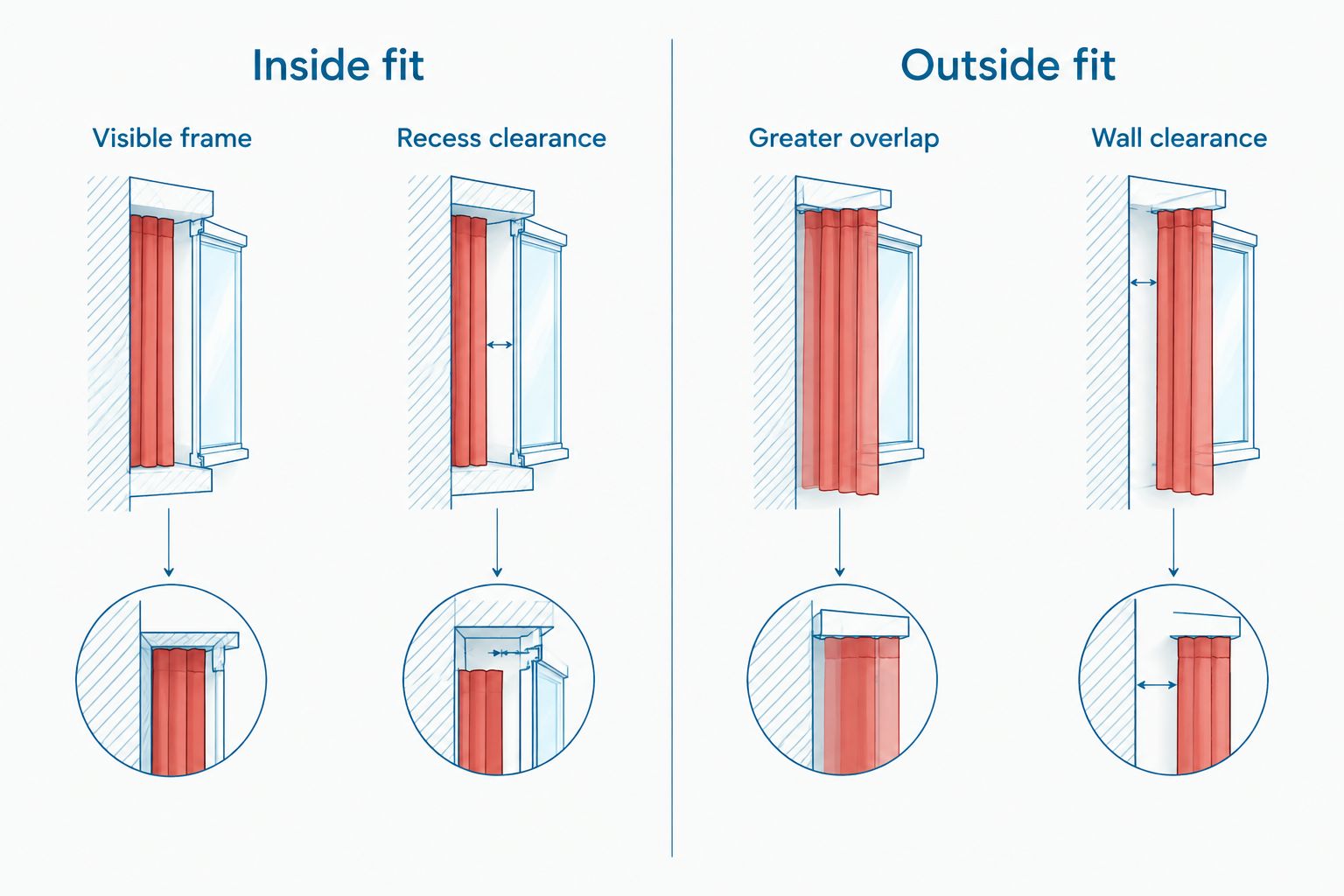
If your window feels bare but curtains would crowd the room, choose an inside-fit Roman blind when the recess has enough clear depth and you want to show the frame; choose an outside fit when you need more overlap or the recess cannot accommodate the blind. For a bedroom, check edge gaps and the raised fabric stack before choosing the fit—blockout fabric alone does not stop light coming around the sides.
Start with the window, then choose the look. An inside fit sits within the window recess. An outside fit sits in front of the opening, attached to a suitable frame or wall surface.
With Material World, you can discuss custom-made blinds alongside your room’s privacy, light and fabric needs. The right mounting position depends on what surrounds the glass, not simply which photograph you prefer.
| Fit | Best for | Main advantage | Main limitation |
|---|---|---|---|
| Inside fit | Showing off a window frame and keeping the blind contained | Leaves surrounding trim visible and keeps fabric within the opening | Needs sufficient clear depth; operating gaps can admit light |
| Outside fit | Overlapping the opening or working around a shallow recess | Gives more freedom over coverage and raised stack placement | Covers more of the frame or wall and needs a suitable fixing surface |
Neither fit guarantees complete darkness. Ask to see where the fabric edges, brackets and raised folds will sit before approving the finished dimensions.
A Roman blind changes shape as you use it: flat across the window when lowered, then gathered into folds when raised. Those folds need somewhere to sit.
That matters if you want an open outlook, need access to a window handle or have furniture close beneath the sill. A fabric you love still needs a mounting position that lets the window work properly.
For Sydney homes where privacy and daylight compete, consider both the closed and open positions. In Orange and the Central West, the same practical checks apply: assess the actual window, your comfort needs and how you use the room rather than choosing by location alone.
An inside fit suits a window whose frame you want to retain as part of the room. It also keeps the blind visually contained, which is useful when surrounding wall space is limited.
Choose an inside fit only after checking the entire recess. A deep-looking sill does not prove there is enough room at the top, where the blind and its brackets will sit. Handles, locks and the opening movement of the window also need clearance.
The trade-off is light around the edges. The blind needs room to operate without rubbing, so an inside fit is not the same as a sealed cover over the glass.
Before choosing this fit, check:
For a living room, those gaps might be less important than keeping attractive trim visible. For a light-sensitive sleeper, they deserve more attention.
An outside fit lets the fabric extend beyond the window opening. This gives you more control over coverage and can help reduce direct light entering around the edges, depending on the overlap and how far the fabric sits from the wall.
It can also provide space to position the raised folds above the glass. Check the stack position rather than assuming an outside fit will leave the whole window clear. The available wall space and the blind’s construction determine what is possible.
The compromise is a larger visible fabric area. An outside-fit blind can cover decorative trim, sit close to neighbouring joinery or compete with artwork beside the window.
Ask the person measuring to explain the proposed top, bottom and side positions. You should be able to picture the blind lowered without guessing where its edges will land.
The same fit does not suit every window, even within one home. Assess these factors before repeating a mounting position across the room:
A consistent appearance is useful, but it should not make a window awkward to use. Where openings differ, ask how the finished blinds can look coordinated without forcing identical mounting positions.
You do not need installation-ready measurements to start a useful conversation. You do need to show what could obstruct the blind and explain what you want it to solve.
Use these observations to brief the consultation, not to place a finished-size order. A custom-made blind needs the final measuring and fitting details resolved before manufacture.
Fit and fabric solve different problems. An overlapping blind made from a light-filtering fabric will not behave like a lined blind, and blockout lining will not close gaps around an opening.
Bring samples into the room and view them against the window in daylight. Then look at them with your evening lighting: colour, texture and the visibility of the weave can feel different when the light changes.
Material World custom-made Roman blinds are best for homeowners who want fabric and fit chosen together through an in-home consultation. Its Soft Roman Blinds By Material World offer thousands of fabric options and lining choices; the final choice still needs to suit the window’s clearance and the room’s light-control needs.
Custom-made does not remove the physical limits of the opening. It lets you address them deliberately rather than treating fabric choice as the whole decision.
An outside fit can reduce edge light, but it does not guarantee a dark bedroom. Check the fabric, lining, side overlap and top gap together. Explain where unwanted light enters now so the proposed solution addresses that problem.
Yes—different window conditions can justify different fits. Coordinate fabric and the visible alignment where practical, but do not sacrifice window access just to repeat a mounting position.
What’s the best fit for Roman blinds in a Sydney bedroom?
An outside fit is worth considering when reducing edge light is the priority, because it allows overlap beyond the opening. Check lining, mounting distance and gaps as well; the fit alone does not guarantee darkness.
Are inside-fit Roman blinds better for decorative window frames?
Inside-fit Roman blinds suit decorative frames when you want to leave the surrounding trim visible. The recess still needs sufficient clear depth for the blind, brackets and window hardware.
Will an outside-fit Roman blind let me open my window?
An outside fit does not automatically guarantee window clearance. Check the window’s opening movement against the blind’s mounting position and raised fabric folds before approving the fit.
Does blockout lining stop all light around Roman blinds?
Blockout lining addresses light passing through the lined fabric, not light travelling around its edges. Mounting position and overlap need separate attention.
Can I measure for Roman blinds myself?
You can take preliminary measurements and photographs to explain your window. Confirm final manufacturing dimensions and fitting allowances with the person responsible for the custom-made blind.
Can Roman blinds soften a room without full-length curtains?
Roman blinds add fabric and folded detail at the window without requiring full-length curtain panels. Choose the fabric and raised stack position together so the softer look still suits the available space.
The detail that changes your decision might be above the window, not beside it. A cornice, narrow wall strip or projecting trim can determine whether the raised blind sits where you imagined.
With 25+ years of experience and local service in Sydney and Orange, Material World can bring the showroom to you. Request an in-home design consultation and free quote to choose a fit tailored to your home.


