Your cart (0)
Your cart is empty
Tax included and shipping calculated at checkout

Drawer menu
Tax included and shipping calculated at checkout

Choose a feature wall if your room needs a clear focal point; choose designer wallpaper throughout if you want the walls to form a continuous backdrop. Neither approach is automatically better for a small room. The deciding details are where you look when you enter, how the pattern sits around doors and windows, and how it works with your curtains and furniture.
Choose the extent of your wallpaper around the room’s layout, not a rule about room size. A feature wall creates emphasis; a whole-room treatment creates continuity. Both need a plan for where the pattern starts, stops and meets other finishes.
Before choosing, read about choosing designer wallpaper with installation in mind. A pattern you love on a sample still needs to work across the actual wall.
| Approach | Best for | Main benefit | Main drawback |
|---|---|---|---|
| Feature wall | Highlighting a bedhead, fireplace or another clear focal point | Gives the pattern a defined place in the room | Can look disconnected if the surrounding finishes do not relate |
| Whole room | Creating a continuous backdrop around the space | Carries colour and pattern beyond a single viewpoint | Needs more decisions about corners, openings and adjoining rooms |
Your wallpaper does not sit in isolation. You see it beside curtain folds, upholstery, flooring and furniture, often from several positions throughout the day. Choosing the wall coverage before considering those relationships can leave you trying to fix the balance later.
Start with the problem you want to solve. Does the room feel unfinished behind the sofa? Does a bedroom need a softer, more settled backdrop? Is an open-plan space missing a defined dining area? A clear brief makes the choice between a feature wall and a whole room much easier.
A feature wall works well when there is an obvious surface you want to emphasise. Behind a bedhead is a useful starting point because the furniture already gives that wall a purpose. A dining wall or the wall behind a sofa can serve the same role.
Choose the focal wall first, then choose the pattern. Do not select the smallest wall simply because it feels like the safest commitment. Check whether people will actually see it from the doorway and from the places where they sit.
The advantage is focus. You can give a distinctive pattern room to stand out without carrying it around every corner. The compromise is that the remaining walls need to feel intentional, rather than simply left over.
Connect them through a related paint colour, curtain fabric or upholstery detail. They do not need to match exactly; they need to belong together.
Whole-room wallpaper suits a space where you want the walls to read as a connected backdrop. Instead of directing attention to one surface, you carry the same visual language around the room.
That does not require a bold print. A quiet pattern or textured-looking design can create continuity without becoming the main event. Equally, a stronger pattern can be a deliberate choice when you want an enveloping room rather than a restrained backdrop.
The benefit is consistency from different viewpoints. The drawback is that you must resolve more junctions: corners, door frames, window reveals and the point where the room meets a hallway or adjoining space.
Before committing, stand in the doorway with your sample, then move to your usual seat. Choose whole-room coverage only when you like the pattern as a surrounding backdrop, not just as a small decorative detail.
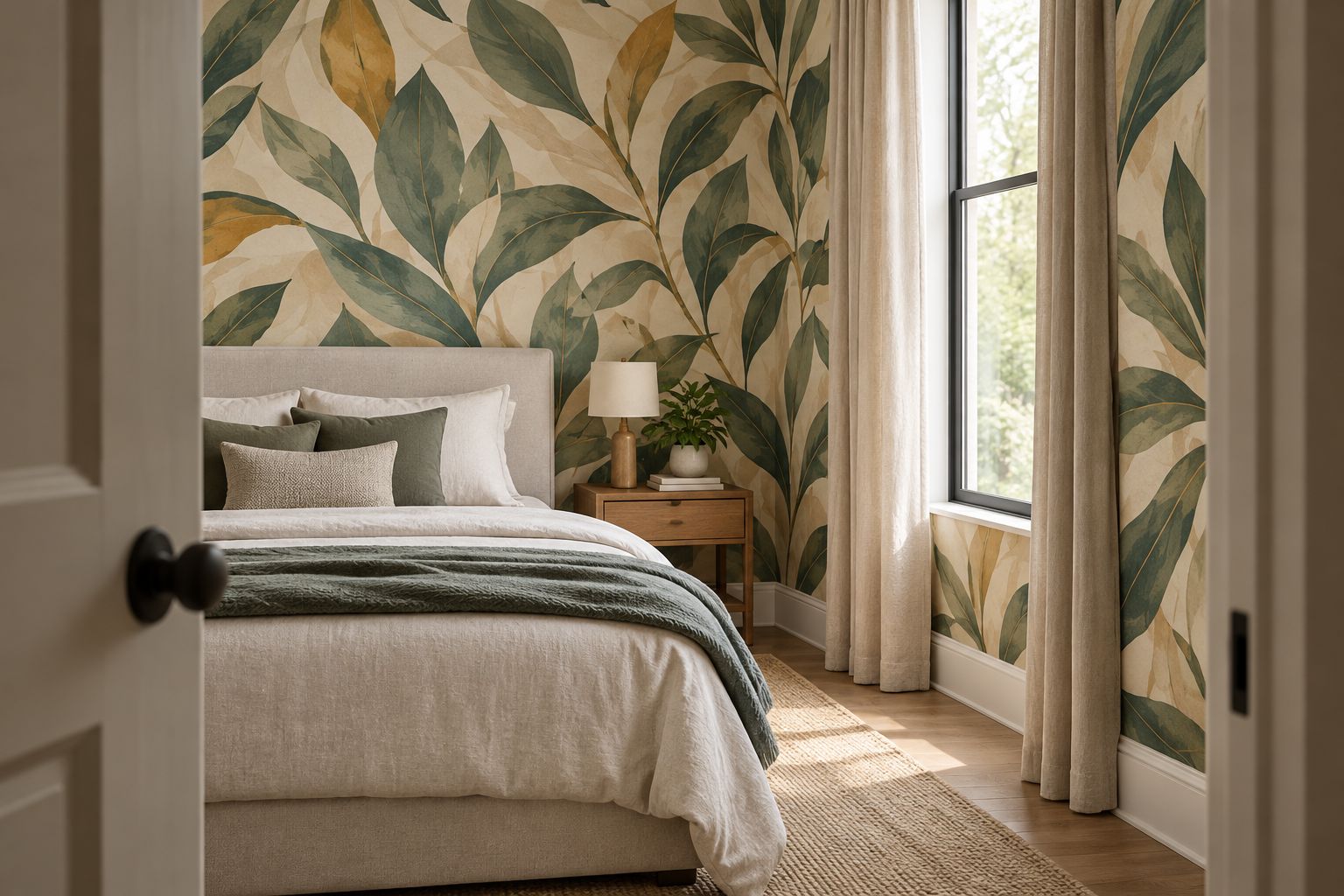
Use these practical checks to decide how far the wallpaper should extend:
Start with the element you are keeping. If your sofa, rug or curtains already have a strong pattern, use those as the reference for your wallpaper choice. If the room is a fresh start, choose the element you feel most strongly about and build around it.
A useful exercise is to place the wallpaper, curtain fabric and upholstery fabric together on a clear surface. Look for what repeats and what competes. Several patterns with similar visual emphasis need more careful balancing than a scheme with one clear lead.
Material World’s custom-made curtains and broad fabric selection give homeowners and designers a way to consider those choices together. The window furnishings are genuinely custom-made rather than factory mass-produced, so discuss fit and function alongside the fabric.
Wallpaper sets the visual backdrop; curtains and blinds address the window. If privacy, blockout or light control is part of your brief, keep those needs separate from the wallpaper decision. A coordinated look still needs to work for everyday living.
Follow this sequence before settling on a feature wall or whole-room treatment:
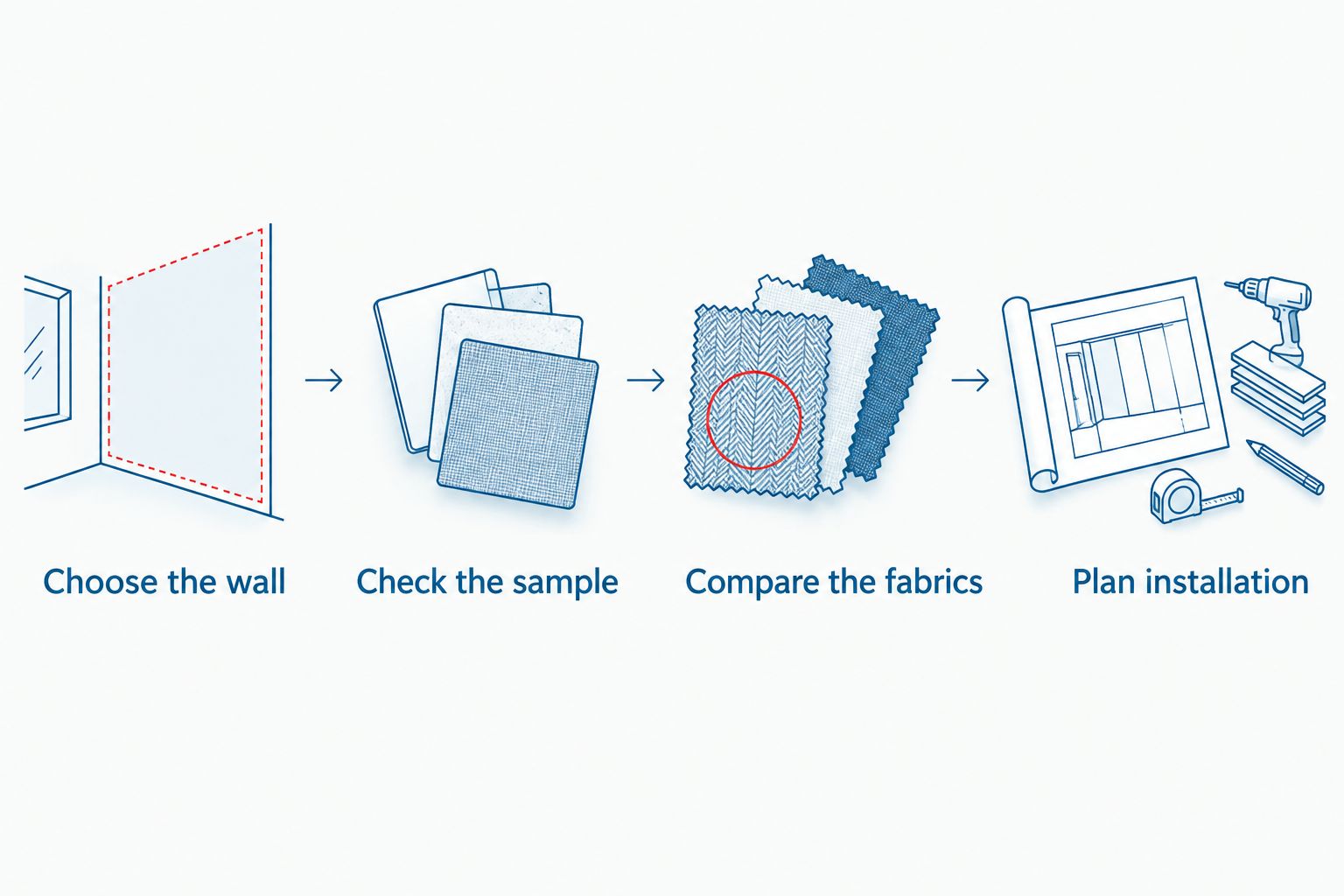
Treat wallpaper as a supply-and-installation project, not simply a pattern purchase. Material World offers designer wallpaper supply and installation; confirm the scope and service coverage for your address before making arrangements. Keep wall preparation, wallpaper supply and installation clear in the quote so you understand what the work includes.
A small room does not automatically need a feature wall. Test whether the wallpaper works as a continuous backdrop and whether the furniture leaves enough of the design visible. Room size alone does not settle the choice.
Your curtains do not need to match your wallpaper exactly. A shared colour or a compatible plain fabric can connect the two without repeating the same pattern. Choose the curtain’s privacy and light-control function before finalising its appearance.
Is designer wallpaper better on a feature wall or throughout a room?
Designer wallpaper suits a feature wall when you want emphasis and a whole room when you want continuity. Choose according to the layout, sightlines and relationship with your furniture and fabrics.
Which wall should I choose as a wallpaper feature wall?
Choose the wall that supports the room’s intended focal point, such as the wall behind a bedhead or sofa. Check the view from the doorway and your usual seating position before deciding.
Will wallpaper make my small bedroom feel too busy?
Judge the wallpaper alongside your bedroom’s furniture and fabrics rather than by room size alone. Test the sample from across the room and consider how much pattern you want around you.
Can I use patterned curtains with patterned wallpaper?
You can combine patterned curtains and wallpaper, but compare physical samples together before committing. Give the scheme a clear lead rather than asking every surface to attract equal attention.
Do I need to think about installation before choosing wallpaper?
Plan installation before confirming the wallpaper. Discuss wall preparation, pattern placement, corners and finishing points so the design works across the actual surfaces.
Can Material World help with wallpaper and window furnishings?
Material World offers designer wallpaper supply and installation alongside custom-made curtains, blinds and a wide fabric selection. Confirm wallpaper service coverage for your address and discuss your window-furnishing needs as part of the room scheme.
Do not judge the wallpaper only while standing directly in front of it. Sit where you normally read, eat or watch television, and check the sample from there. The best choice is the one you enjoy from your everyday position, not just the doorway.
Struggling to visualise the finished room? Ask Material World about an in-home design consultation and free quote for your custom curtains or blinds—bring the showroom to you and consider the fabrics alongside your wallpaper sample.


