Your cart (0)
Your cart is empty
Tax included and shipping calculated at checkout

Drawer menu
Tax included and shipping calculated at checkout

Linen curtain fabric does not always need a separate lining: leave it unlined when you want filtered light, or add a suitable backing when you need privacy or blockout. The key distinction is whether the lining moves with the linen or operates independently behind it. For a bedroom that needs both an airy daytime look and darkness at night, independently operated layers give you more control.
No—choose the lining arrangement around what your room needs, rather than the fibre name. A sheer linen curtain, a lined decorative curtain and independently operated layers solve different problems. Start by deciding whether the window needs to soften daylight, screen a view or darken a sleeping space.
If you are struggling to visualise your new room, Material World offers expert in-home design consultations and genuinely custom-made curtains, rather than factory mass-produced furnishings. That makes the fabric, lining and fit part of the same conversation.
| Arrangement | Best for | Main benefit | Main limitation |
|---|---|---|---|
| Unlined linen | Soft daylight where privacy is already managed | Keeps the fabric's light, open appearance | Sheer fabric does not provide dependable night-time privacy |
| Attached lining | Curtains you want to open and close together | Adds backing without operating another curtain separately | You cannot open the backing while keeping the linen closed |
| Separate lining | Rooms needing different daytime and night-time settings | Lets you control the linen and backing independently | Needs a suitable track arrangement and space for both layers |
A linen sample can look quite opaque on a table, then become much more transparent against a bright window. At night, the balance changes again: a lit room behind a sheer curtain can be visible from outside. Judge privacy at the window, not against a sample book.
Lining also changes the finished appearance. Adding backing can make a light curtain look fuller and less translucent, which is helpful in some rooms but works against an intentionally airy effect. Decide which look you want before choosing the construction.
Choose unlined linen when your main aim is to soften the window and filter daylight. It works particularly well when another covering already handles privacy and blockout. You keep the visible texture without asking the linen to do every job.
The trade-off is exposure. An open weave lets light through, and the amount you can see through it depends on the fabric and lighting conditions. Closing a sheer curtain is not the same as closing a privacy curtain.
For an existing room, check what your current blind already does before adding another backing. If it provides the night-time privacy you need, an unlined linen layer can focus on making the room feel softer. Check that the curtain clears the blind and its controls.
Attached lining sits behind the face fabric and moves with the curtain. It suits you when you want a single opening-and-closing routine, rather than adjusting the decorative layer and backing separately. The exact attachment method belongs in the curtain specification.
Ask for the lining's actual function to be stated. Ordinary lining and blockout lining are not interchangeable descriptions. If darkness is the priority, choose a suitable blockout backing and discuss the whole window arrangement, including gaps around the edges.
The compromise is flexibility. With an attached backing, you cannot leave the linen across the window while drawing only the lining aside. You also need to see the proposed combination together, because the backing affects how the linen's colour and weave appear.
A separate lining hangs behind the linen and operates independently. You can leave the linen closed for softer daylight, then close the backing when privacy or darkness matters. This is useful when the room serves different purposes across the day.
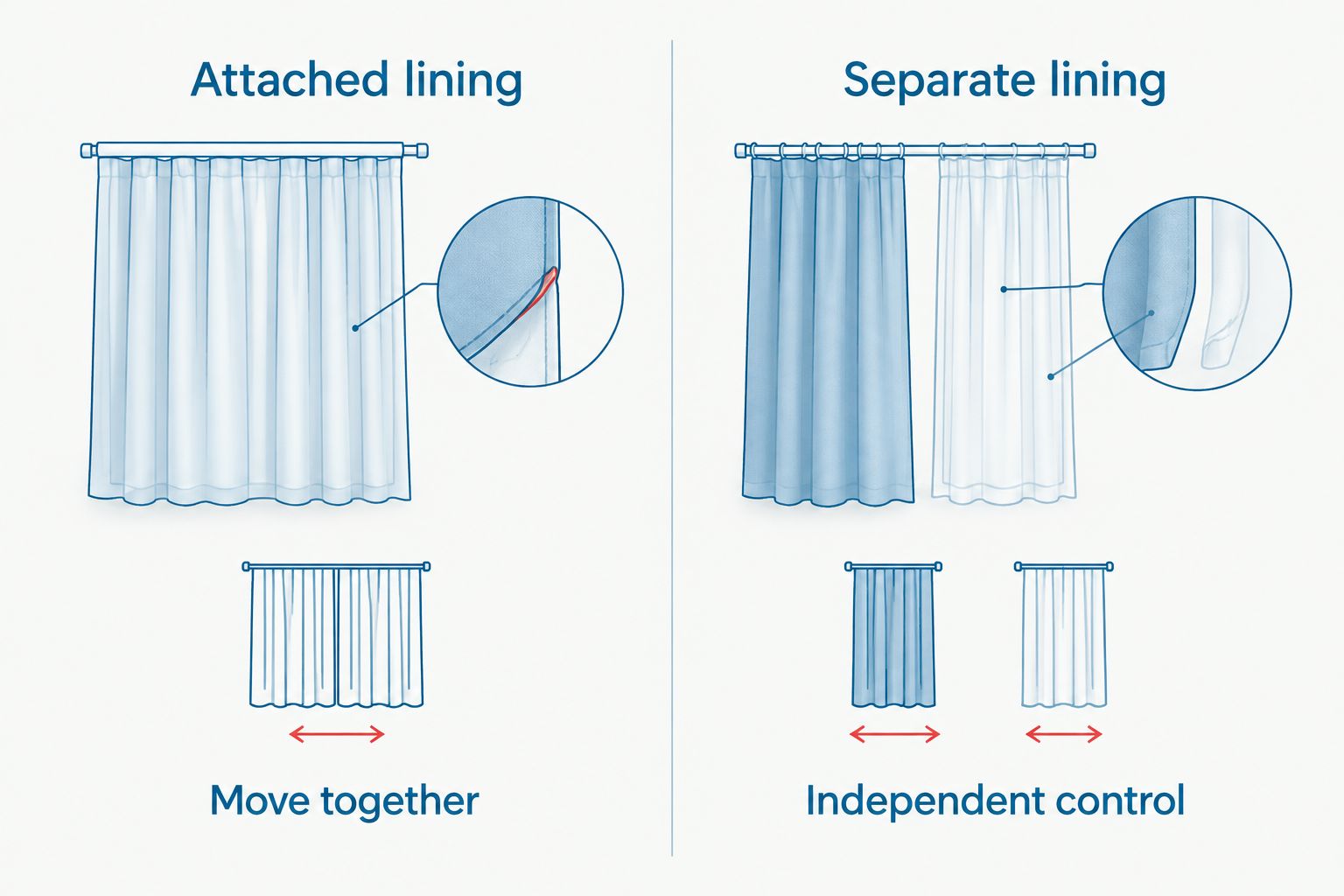
The extra layer needs planning, not just extra fabric. Check the track arrangement, clearance from handles and blinds, and where both curtains gather when open. A narrow wall beside the window can make the gathered fabric more noticeable.
Separate lining is not automatically the better choice. If you always want both layers in the same position, independent operation adds a task without solving a room problem. Choose it because you need different settings, not because more layers sound better.
Use these checks to narrow the decision before comparing colours:
Treat insulation and noise reduction as separate questions, too. Extra fabric does not establish a particular thermal or acoustic result. If traffic noise or room comfort is your main concern, explain that first and ask what the proposed curtain construction is intended to achieve.
Hampton Linen is one example where the fabric description gives useful direction. It is a pure linen sheer with a 300cm fabric width, recommended for a puddling drape, and its description also recommends a lining. That guidance is a reason to discuss the finished construction before ordering.
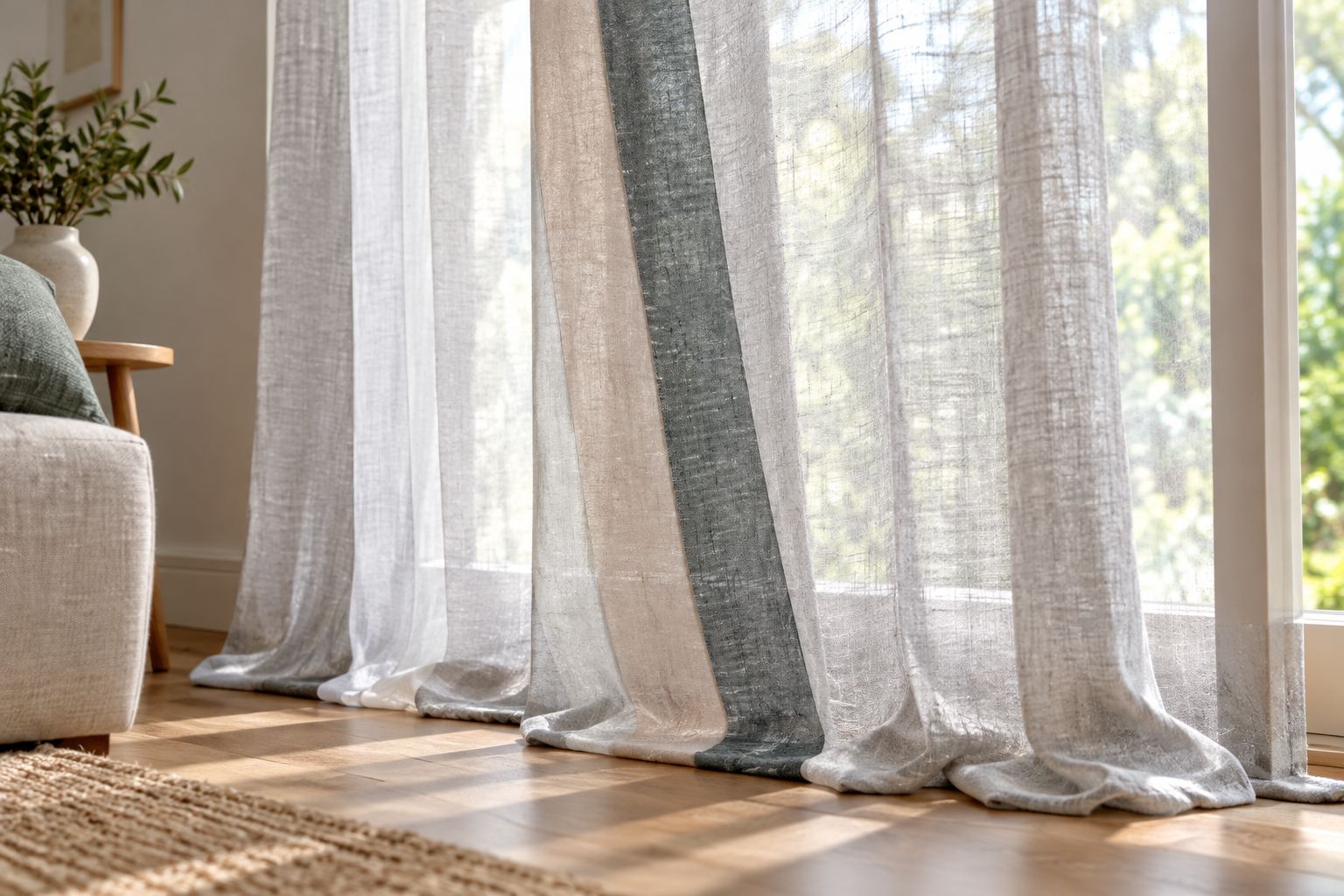
Best for: an airy linen look where you are comfortable with the recommended puddling finish. The practical drawback is fabric resting on the floor, which needs consideration around cleaning, pets and frequently used doors. Fabric width alone does not tell you the finished curtain size or how much fabric your window requires.
Do not transfer one fabric's recommendations to every linen. Ask to see your selected fabric with the proposed lining behind it, then confirm the heading, hem position and care instructions together.
Linen curtains can provide privacy without lining only when the selected fabric and lighting conditions support it. A sheer linen should not be your only night-time privacy measure. Check a sample against the window and consider the view from outside when the room is lit.
If another blind already provides privacy, keep the linen's role clear. It can soften the room while the blind handles screening, without an unnecessary additional layer.
Blockout lining stops light passing through the backing, but gaps can still let light into the room. The top, sides, centre overlap and lower edge all matter. Specify the fabric and fit together rather than expecting the lining alone to deliver darkness.
For a light-sensitive sleeper, describe the problem precisely during the measure. Early sun at the side of the window needs a different discussion from light passing through the curtain fabric itself.
Do all linen curtains need a separate lining?
No, linen curtains do not all need a separate lining. Choose unlined, attached or independently operated layers according to the fabric, privacy needs and light control you want.
Is attached lining better than separate lining?
Attached lining is better when you want the linen and backing to move together. Separate lining is better when you want to adjust daylight and privacy independently.
Can I put linen curtains over my existing roller blinds?
Yes, linen curtains can work over existing roller blinds if the track position and clearances suit the window. Check that the curtain does not obstruct the blind or its controls.
Will a linen sheer give me privacy at night?
A linen sheer does not provide dependable night-time privacy when the room is lit. Use a suitable privacy backing or existing blind rather than relying on the sheer alone.
Does lining change how linen curtains look?
Lining changes how much light passes through linen and can change its apparent colour, texture and fullness. View the selected fabric and backing together before deciding.
Can I wash linen curtains and their lining together?
Only wash linen curtains and their lining together when the care instructions for the complete curtain allow it. Confirm the face fabric, backing and construction requirements before cleaning.
Ask to see the linen with and without its proposed backing at your own window. That simple comparison helps you judge the light, texture and privacy together, instead of choosing each component in isolation.
Material World brings 25+ years of experience, a large premium fabric selection and local service in Sydney and Orange. The business is 100% Australian owned and operated, with custom curtain advice tailored to your home.
Let Material World bring the showroom to you: arrange an in-home design consultation and request a free quote for your linen curtains.


