Your cart (0)
Your cart is empty
Tax included and shipping calculated at checkout

Drawer menu
Tax included and shipping calculated at checkout

Sydney bay-window Roman blinds are fabric blinds that fold upwards, tailored to angled window sections to give you privacy and a softer room without full-length curtains. If your bay feels exposed or crowded, start with how you use the space: the right solution needs to clear handles, preserve window access and fold neatly above each pane.
A bay window is not one flat opening. Its angled sections create meeting points where neighbouring blinds, brackets and folds need room to work without touching.
Roman blinds bring fabric into that space without requiring curtains to gather beside every pane. They suit homeowners who want a softer finish around a window seat, dining nook or living-room bay. Their limitation is the folded fabric: when raised, it still occupies space above the glass.
Material World is best for Sydney homeowners seeking custom Roman blinds with in-home design advice. With 25+ years of experience, Material World offers genuinely custom-made window furnishings rather than factory mass-produced alternatives, alongside a large premium fabric selection.
The useful starting point is your room, not a fabric swatch. Decide whether the main problem is overlooking, glare, interrupted views or a window that feels visually bare.
Watch how you use the bay through the day. A dining nook needs a different balance from a bedroom: enjoying filtered daylight is not the same brief as darkening a room for sleep.
Write down your top 2 priorities before choosing fabric. This keeps an attractive sample from distracting you from the reason you wanted new blinds.
Privacy also changes after sunset. A fabric that softens the view during daylight needs checking under indoor lighting rather than being assumed private at night.
You can prepare a rough sketch and photographs yourself. Mark the angled joins, handles, window seat and any existing fittings, then note where a blind would sit when lowered and raised. Leave final manufacturing measurements to the person specifying the installation.
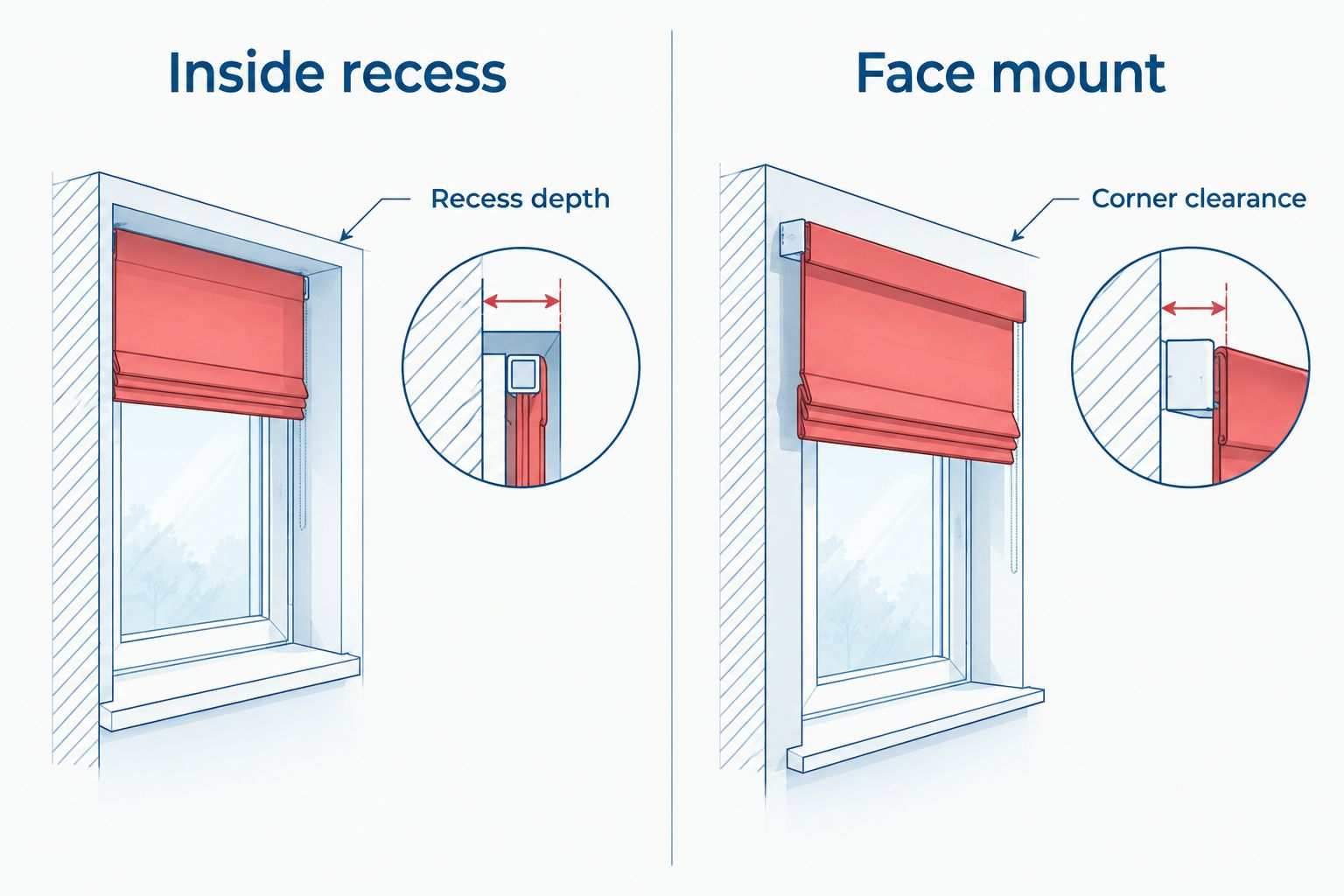
Do not assume apparently matching panes are identical. Mounting depth and corner clearance need checking across the whole bay, not just its widest section.
Material World's expert in-home design consultations bring the showroom to you, making it easier to discuss fit in the actual room. The advantage is advice tailored to your home; the trade-off is that the finished specification needs a room assessment rather than a decision from a photograph alone.
An inside-recess fit keeps the blind within the window opening and leaves more surrounding trim visible. It also needs enough depth for the chosen system and clearance from handles.
A face-mounted blind sits outside the recess. It can cover more of the opening, but a bay's angled joins still need careful planning. Neither approach automatically removes every light gap.
Ask to see where the raised folds will sit before approving the mounting position. That decision affects your view, not just how the blind looks when closed.
An unfamiliar mounting detail is easier to resolve at the window than after the fabric is selected. Ask the consultant to explain the proposed position in everyday terms.
Bring samples beside your wall colour, flooring and upholstery. A fabric that looks calm on its own can feel quite different when repeated across several angled panes.
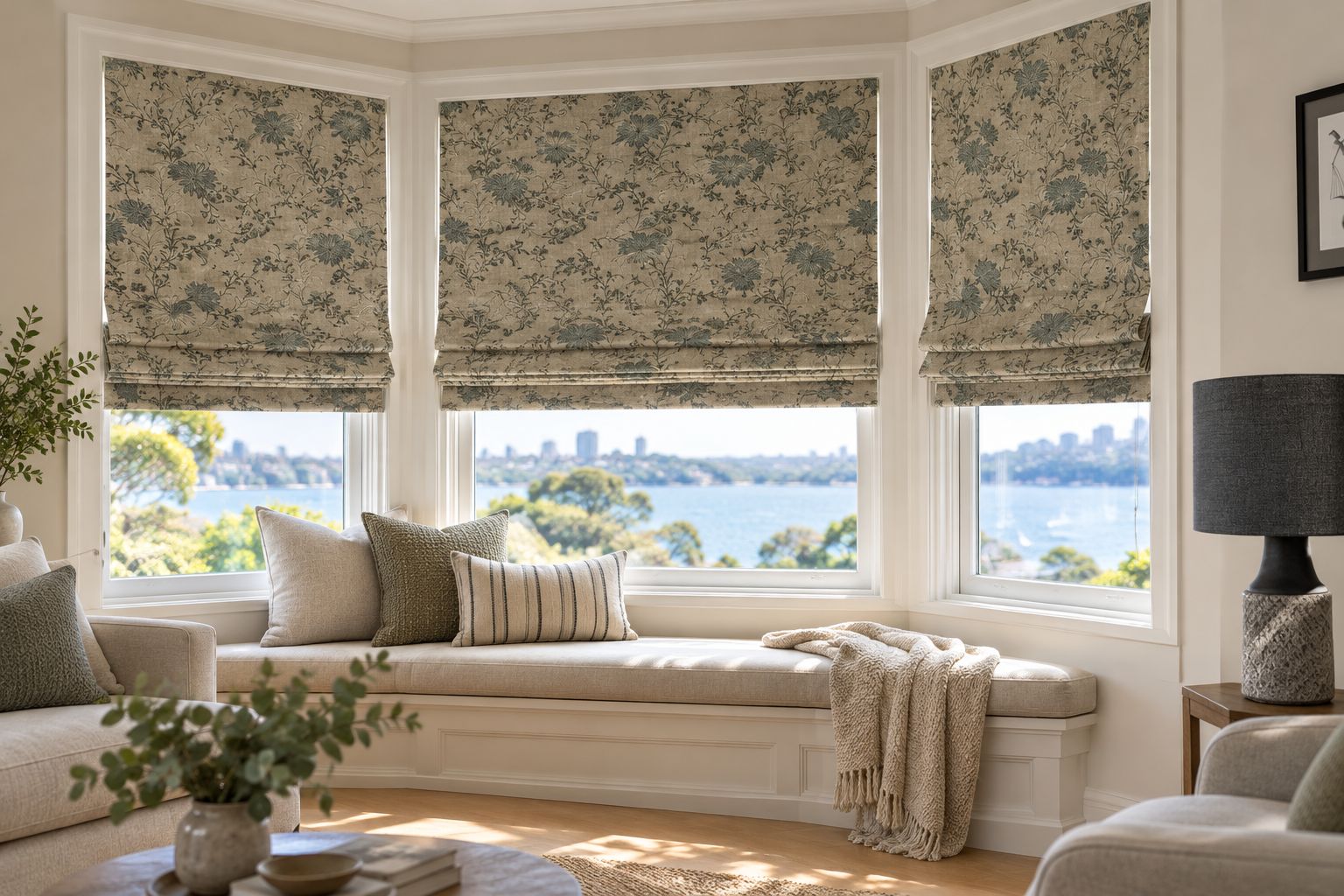
For a soft, coordinated result, consider texture as well as colour. A strong pattern needs another conversation: ask how its placement will look across separate blinds and within the folds.
Material World offers a large premium fabric selection, but not every fabric is suitable for every blind construction. Let us help you choose by narrowing the selection to fabrics that suit the proposed Roman blind, lining and room.
Lining belongs in the same discussion as fabric. It affects the finished result, while the mounting and surrounding gaps remain part of any blockout plan.
Imagine opening and closing every section from where you will actually stand. A window seat or deep sill can make an otherwise suitable control awkward to reach.
Ask about compliant child-safe operation and installation, particularly where children can climb onto furniture near the window. Australian blind-cord safety requirements make this an installation issue, not an optional finishing detail.
For interior designers, record the agreed mounting, fabric, lining and control arrangement together. Homeowners benefit from the same written clarity: a fabric name alone is not a finished specification.
Choose by the room problem rather than treating every window furnishing as interchangeable. Each option has a useful role and a practical limitation.
| Option | Best for | Main advantage | Key limitation |
|---|---|---|---|
| Custom Roman blinds | A soft fabric finish without full-length curtains | Separate blinds can serve individual bay sections | Raised folds occupy space above the glass |
| Roller blinds | A simpler finish with less folded fabric | Fabric rolls upwards rather than forming stacked folds | They do not provide the same folded-fabric appearance |
| Curtains | A continuous fabric treatment around the bay | Fabric can frame the whole window area | Tracks and gathering space need planning around the angles |
| Roman blinds with curtains | Rooms wanting both a framed bay and individual blinds | Combines separate window control with a curtain treatment | Requires space for both systems without interference |
For a window seat, start by comparing Roman and roller blinds. For a room where the fabric treatment should frame the whole bay, include curtains in the discussion. Keep noise reduction and insulation as separate questions: appearance alone does not establish performance.
Are Roman blinds a good choice for a Sydney bay window?
Roman blinds suit bay windows when you want a soft fabric finish without full-length curtains. Check each angled section, corner clearance and the space occupied by raised folds before choosing the final design.
Should each section of a bay window have its own Roman blind?
Separate blinds are a useful starting point for an angled bay because they can serve individual window sections. Confirm the arrangement against the actual frame, corner joins and how you use each window.
Can Roman blinds make a bay-window bedroom completely dark?
Blockout lining alone does not guarantee a completely dark bedroom. Light can enter around the edges, so assess lining, mounting and gaps together.
Are Roman blinds better than roller blinds for a window seat?
Roman blinds are better for a folded-fabric look; roller blinds suit a simpler rolled finish. Either choice needs clearance from the seat, handles and neighbouring fittings.
Can I measure a bay window for Roman blinds myself?
You can prepare rough measurements, photographs and a sketch for a consultation. Have final manufacturing measurements checked with the proposed mounting system and corner clearances.
Does Material World offer in-home advice for Roman blinds in Sydney?
Material World offers expert in-home design consultations and free quotes in Sydney, with local service also in Orange. A consultation lets you discuss fabric, lining and fit in the room where the blinds will be used.
Ask to see the proposed blind position both fully lowered and fully raised. You live with both views, and the raised position is easy to overlook when you are concentrating on fabric.
Request an in-home design consultation and free quote to discuss Roman blinds tailored to your Sydney bay window.


