Your cart (0)
Your cart is empty
Tax included and shipping calculated at checkout

Drawer menu
Tax included and shipping calculated at checkout

If your room feels exposed or the daylight looks harsh, choose sheer curtain fabric by checking how its weave filters light at your own window, rather than choosing by colour alone. An open weave keeps a lighter, more transparent look, while a closer weave offers more visual screening; neither replaces a blockout layer when you need darkness or dependable night-time privacy.
Start with what bothers you most: glare, overlooking or a window that feels bare. Then compare samples against the glass, both spread out and gathered into folds, so you can see the balance between light, view and coverage.
Use this table to narrow the direction, not to assume that every fabric within a group performs identically. The actual sample decides.
| Fabric direction | Best for | Main benefit | Main limitation |
|---|---|---|---|
| Open weave | Keeping a connection to the garden or outlook | An airy appearance with greater transparency | Offers less visual screening |
| Closer weave | Softening a strongly lit or overlooked window | More coverage than a visibly open weave | Reduces the clarity of the view |
| Decorative sheer | Making the window part of the room’s design | Adds pattern or embroidered detail | The pattern becomes another element to coordinate |
If you are unsure how to compare these at home, the guide to preparing for a custom curtain consultation in Sydney helps you organise your room priorities before choosing fabric.
A sheer can look almost solid against a showroom wall and surprisingly transparent against a bright window. You are choosing how the fabric behaves with light behind it, not just how it looks on a sample hanger.
Choose for the room’s hardest moment, not its prettiest moment. If afternoon sun makes your sitting area uncomfortable, assess the sample then. If overlooking is the problem, check the view from outside as well as inside.
An open weave suits a room where you want the window softened without visually closing off the garden or balcony. Look through the sample from your normal seat, rather than judging it only at arm’s length.
The trade-off is screening. Visible gaps between yarns help explain why an open sheer should not be your only answer for a closely overlooked room.
Choose an open weave when preserving the outlook matters more than increasing coverage. If privacy is the priority, compare a closer weave alongside it before deciding.
A closer weave is a useful starting point when a bright window feels too exposed. It creates a more continuous fabric surface, although the amount of light filtering still depends on the specific fabric, colour and curtain folds.
Do not judge density by touch alone. A fabric that feels substantial can still reveal silhouettes when backlit, so hold the sample at the window and check it from different positions.
Choose a closer weave when you want more screening and can accept a less distinct view. It is still a sheer, not a blockout solution.
An embroidered or patterned sheer brings detail to the window without relying on a solid curtain surface. It can work particularly well when the surrounding walls and furniture are quiet enough to let the fabric be the feature.
The limitation is visual competition. Check the pattern beside your rug, cushions and upholstery, and ask to see enough fabric to understand the design rather than choosing from a tiny section.
These factors explain why a fabric recommendation needs more than a photograph:
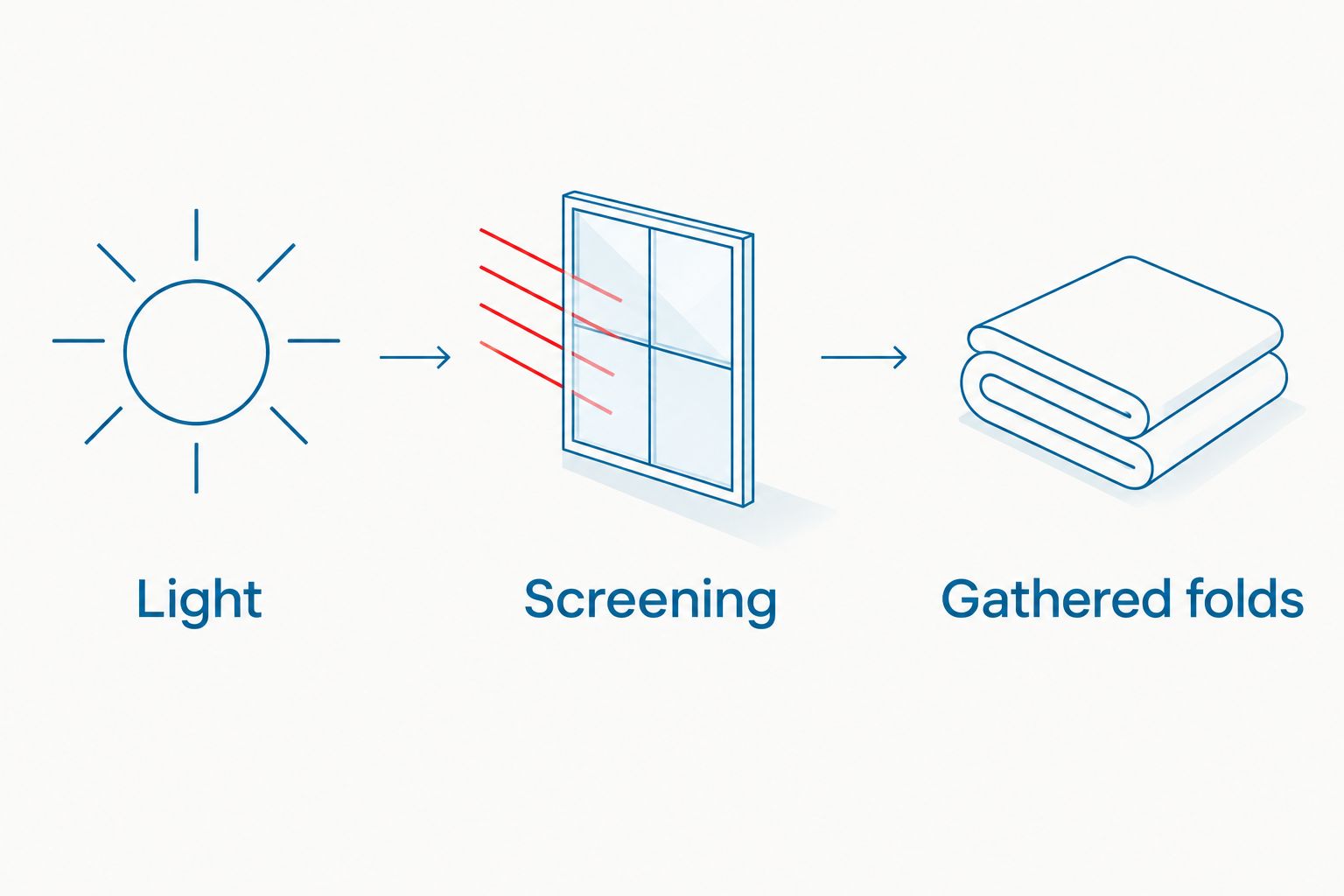
Keep the comparison simple: first judge light, then screening, then the fabric’s appearance in folds. This stops a beautiful texture from distracting you from the problem you need to solve.
Material World’s sheer curtain fabric selection includes embroidered, linen and linen-blend options. These examples give you different starting points for a consultation; they are not interchangeable privacy or glare-control ratings.
| Fabric | Best for | Confirmed detail | What to check before choosing |
|---|---|---|---|
| Orchard Tree Sheer | Homeowners wanting embroidered detail | An embroidered fabric suitable for sheer curtains | Whether the design works with nearby patterns |
| Magnolia Grande Sheer | Homeowners specifically seeking linen | Made from 100% linen | How the actual sample hangs and its care requirements |
| Paradiso Linen Sheer | Homeowners seeking a closer woven texture | A tightly woven linen-polyester blend | Whether its transparency suits the window |
Magnolia Grande Sheer offers a natural-fibre direction, but fibre content alone does not tell you how much privacy a curtain provides. Look at the fabric backlit and gathered before making that decision.
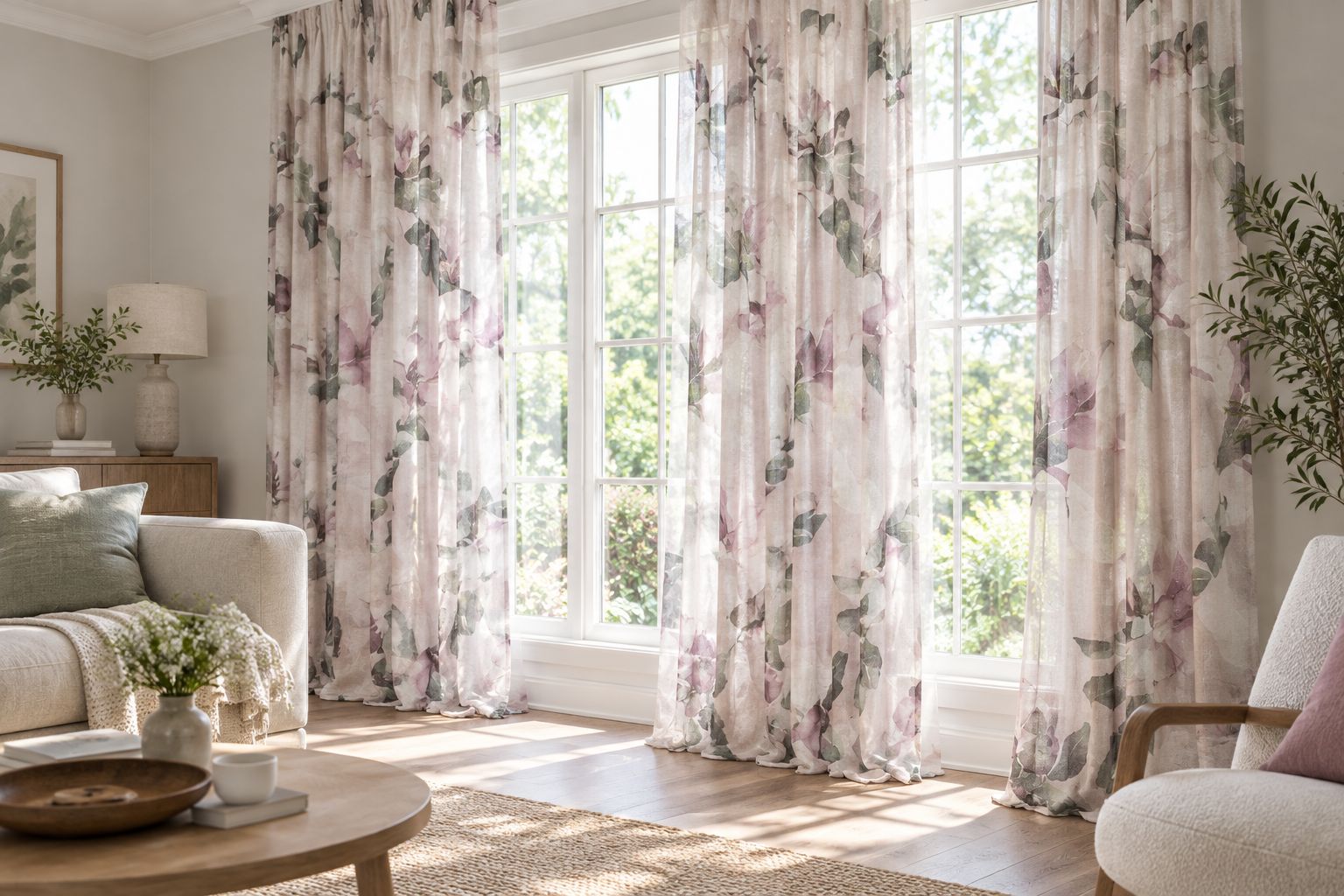
Paradiso Linen Sheer is the closer-weave starting point in this selection, while Orchard Tree Sheer introduces embroidery. Neither description establishes a night-time privacy level: that needs checking in the room with the proposed curtain arrangement.


Sheer curtains are not a dependable stand-alone solution for night-time privacy. When your room is lit and it is darker outside, visibility through the fabric changes.
Plan a separate blind or curtain layer where privacy matters after dark. Keep the sheer for daytime softness and use the other layer when you need coverage, rather than asking one fabric to do incompatible jobs.
A closer sheer weave is not a guarantee of glare control. Direct sun, screen position and the chosen fabric all affect whether your room remains comfortable.
For a home office, check the fabric while sitting at your desk with the screen in its usual position. If the bright patch remains distracting, discuss a separate light-control layer rather than simply choosing a heavier-looking sheer.
Use this short checklist with your homeowner or designer brief:
Material World brings 25+ years of experience to genuinely custom-made curtains, rather than factory mass production, with in-home design consultations in Sydney and Orange. The benefit is a solution tailored to your home; the limitation is that you still need to settle the fabric, fit and light-control brief before ordering.
What’s the best sheer curtain fabric for a bright living room?
The best sheer curtain fabric balances light filtering with the view and privacy you want. Compare an open and a closer weave at your own window before choosing.
Can people see through sheer curtains during the day?
People can see through sheer curtains in some conditions. Visibility depends on the fabric, folds and the difference between indoor and outdoor light, so check from outside.
Are linen sheers better than linen-polyester sheers?
Neither is automatically better for every room. Compare the actual fabrics for appearance, drape, transparency and care rather than choosing by fibre name alone.
Can I keep my roller blind behind new sheer curtains?
You can combine sheer curtains with an existing roller blind if the proposed fit leaves enough clearance for both to operate. Confirm the track position, fabric folds and blind access before ordering.
Will sheer curtains make my bedroom dark enough for sleep?
Sheer curtains are not a blockout solution for a bedroom. Add a suitable separate blind or curtain layer when darkness is part of your brief.
Should I choose sheer curtain fabric from an online photo?
Use an online photo to shortlist the look, not to make the final fabric decision. Check a physical sample against your window and room finishes.
The flat sample is only half the picture. Ask to see your preferred sheer gathered: overlapping folds can change the apparent colour, coverage and pattern before anything else in the room changes.
For help choosing sheer curtain fabric, book an in-home design consultation and request a free quote from Material World. Let us help you choose and bring the showroom to you, whether your home is in Sydney or Orange.


